It isn't luck, and it isn't inside information
Two people watch the same chart, on the same day, in the same stock. One loses money and decides the whole thing is rigged. The other quietly adds to an account that has grown for years. Neither is smarter than the other.
It's the same with two nasi lemak stalls on the same street. Same menu, same prices, same customers walking past. Three years later, one has a second branch and the other is exactly where it started. The difference isn't the nasi lemak.
This book is about what the difference actually is.
Most people pay their tuition before they know what to learn
Trading is full of fraud, and you've probably seen it: signal groups promising easy calls, “secret” indicators sold for thousands of ringgit, gurus selling courses on getting rich instead of just getting rich. No wonder so many people decided the market itself is the scam.
How the numbers you see online are made to look good
- One trade, not the year. A screenshot of a single trade up 100%, from someone whose account is down for the year.
- A big percentage on a tiny account. +200% on RM500 is RM1,000. It says nothing about whether it works with real money.
- Leverage left out. A return made with borrowed money, shown as if it wasn't.
- Wins posted, losses deleted. The winning trades get a post. The losing ones never existed.
- Win rate without the size of the losses. “80% accurate” means nothing if the other 20% wipe out everything.
None of these is a lie on its own. Each one just leaves out the part that matters. That's why the next section shows you the year, the losing months and the leverage, not one good trade.
The expensive mistake isn't losing money on a trade. It's paying for the wrong lessons first. Before you spend on anything, you should know what the road actually looks like, how long it takes, and whether you can stand it.
The record behind the book
I've traded stocks on Bursa Malaysia and the US markets since 2022. This book is built on about 100 closed positions across four broker accounts, shown in percentages only.
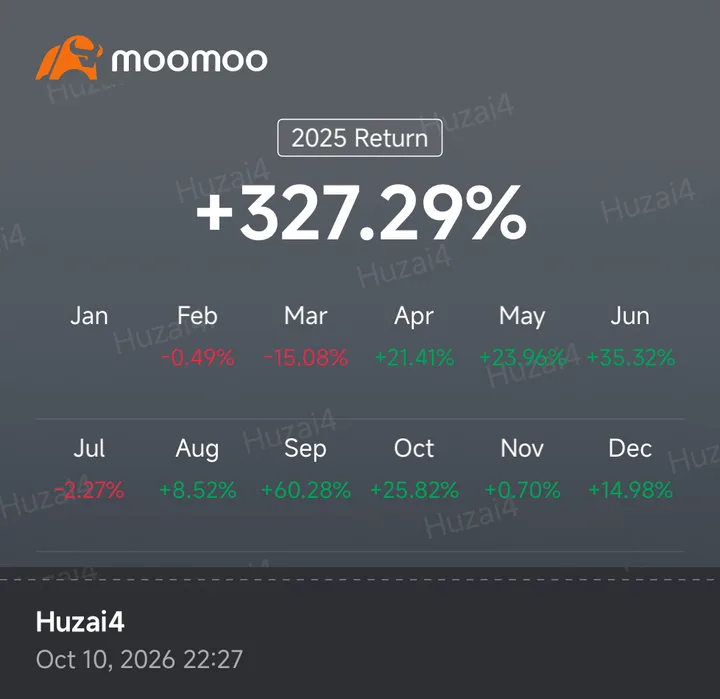
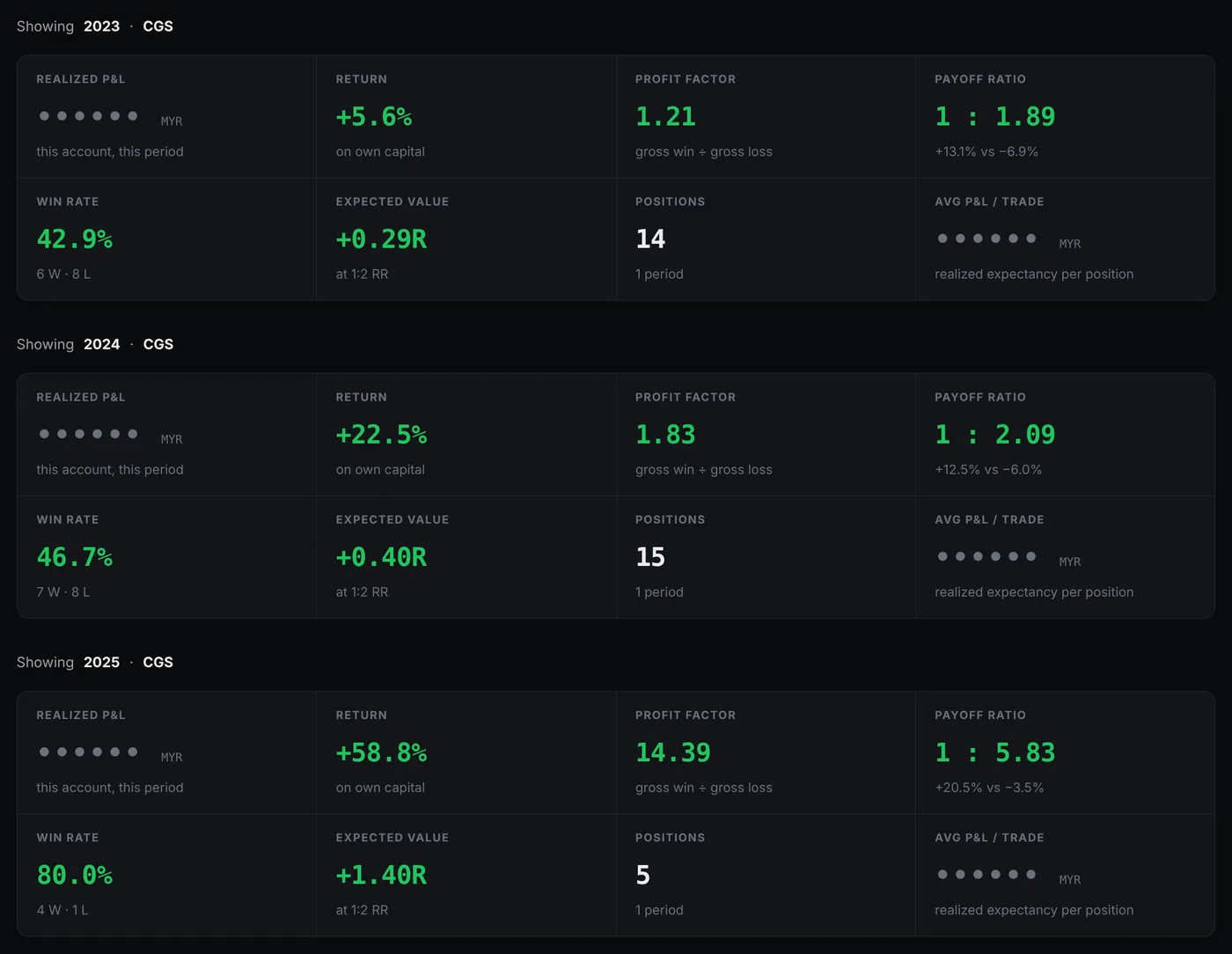
Past, closed trades, shown to explain how trading works. Each account's percentage is on its own balance and is never added to another's. Not a forecast, and not an offer.

Why I wrote it
I started as a programmer. Code was the thing I loved. Over time I moved into software strategy, co-founding Duoz Technology and working on the direction of web and mobile apps: UI and UX with the team, planning features, deciding what gets built.
The part of that work I enjoy most is optimising. When a product isn't working, the answer is rarely to add more. It's to make what already exists work better. That habit is what pulled me into the stock market, because trading turns out to be the same game: not more trades or more indicators, but fewer, better decisions.
I never planned to write a book. Friends saw my statements and asked me to teach them. Enough of them asked that answering properly started to feel like a responsibility. This is the answer, written once, so it's the same for everyone.
I also built two free tools mentioned in the book: an expected-value calculator and a trade ledger that turns your statements into a dashboard.
— Huzaifah Za'ba
The questions it answers
- Is it actually possible to make money in the stock market?
- Why do some people lose and others win, in the same market, on the same moves?
- What separates a trader who makes it from one who doesn't?
- What do you need to do, in what order, if you want to try?
Five parts
- 1It's all bullshit. And why it isn't. Your doubt, taken seriously, then tested against one real trade with the chart and statements behind it.
- 2How the market actually works. What price is, what a chart records, where the money in a trade comes from, and the arithmetic that decides whether a way of trading makes money.
- 3Why some suffer and some win. What you do when the plan starts to hurt, and why that matters more than what you know.
- 4Brutally hard, and not for everyone. What it really costs in time, energy and money, and how to find out early and cheaply whether you can stand it.
- 5What now. The road from here, in order, starting with an amount of money that can't hurt you.
29 chapters, 102 pages, 20 original figures and real broker screenshots. PDF.
What's inside: all 29 chapters
Part 1 — It's all bullshit. And why it isn't.
- You Think the Stock Market Is Bullshit. I Don't Blame You.
- Why Almost Everyone Believes the Lie
- What the Stock Market Actually Is
- Proof: One Real Trade (With Receipts)
- So Here's the Real Question
Part 2 — How the market actually works
- "Buy Low, Sell High" Is Not Advice. It's a Mechanism.
- The Chart Is a Recording, Not a Prediction
- Supply and Demand: Where Price Actually Turns
- The Sharks and the Anchovies
- How a Retail Trader Actually Makes Money, Continuously
Part 3 — Why some suffer and some win
- Two Nasi Lemak Stalls
- My Worst Five Trades, in a Row
- What You Control, and What You Don't
- FOMO Is Buying in the Supply Zone
- Cut Loss, and Then Let It Go
- Hikmah Is Only Visible If You Wrote It Down
- The Danger Isn't Comfort. It's Complacency.
Part 4 — Brutally hard, and not for everyone
- Hard, and Tedious (Susah dan Renyah)
- What It Actually Costs
- Watching Is Not Practising
- The Racetrack
- It Might Not Be For You, and That's a Real Answer
Part 5 — What now
- Don't Kill the Income That Funds This
- Build Your Own Playbook
- Start With RM500, and Don't Try to Make Money
- What You're Actually Risking
- Years, Not Months
- Edge, or Streak?
- The Whole Thing, on One Page
What this book is not
- Not a strategy book. There are no setups, entry rules or playbook of mine to copy. It explains why you need your own and what one has to cover, not the technical how-to.
- No signals. Not in the book and not by email.
- No promised returns, anywhere.
- Not financial advice. I'm not a licensed adviser. Companies that appear are closed trades used as worked examples, not tips.
- Not risk-free. You can lose money trading, all of it. A whole part of the book exists because that's true.
Who it's for
- You've never touched the market and want to know if it's real before you do.
- You bought on a tip from a friend or a WhatsApp group, and you're not sure what happened.
- You've studied it for years and still haven't placed a trade.
- You trade, you know your stuff, and the account still isn't growing.
If you're already consistently profitable, with the statements to prove it, you don't need this book.
Get the book
RM49
One PDF, 102 pages. Read it on your phone, tablet or laptop.
- The full book: 29 chapters, 5 parts, 20 original figures and real broker screenshots
- The Bahasa Melayu edition, free, when it's ready
- Pay by FPX online banking or card
Secure checkout by Stripe, sold by Duoz Technology Sdn Bhd. Buying adds you to occasional emails about the book; unsubscribe in one click. Digital download, no refunds. Privacy notice.
Questions people ask before buying
Still unsure? Every question we've been asked, answered plainly. Anything else: [email protected].
Before you buy
What is this book about, in one paragraph?
It explains how the stock market really works, why most people lose money in it, and how to find out cheaply whether trading suits you. It is built on about 100 of the author's own closed trades, shown in percentages, losing months and leverage included. It is not a strategy book and it does not tell you what to buy.
Who is it for?
Four kinds of reader: people who have never touched the market and want to know if it's real; people who bought on a tip and aren't sure what happened; people who have studied for years but never placed a trade; and people who trade, know their stuff, and still aren't growing. If you are already consistently profitable with statements to prove it, you don't need it.
I'm a complete beginner. Will I understand it?
Yes. Part 2 starts from what a price is, using eggs instead of stocks, and every technical term is explained the first time it appears. Short 'New here?' boxes give beginners the extra context.
I already trade. Is there anything in it for me?
Probably the most. Part 3 is about what you do when a trade starts to hurt, Chapter 10 shows how a low win rate can still be profitable, and the front of the book tells experienced readers which Part to start with. 'Been burned?' boxes speak directly to people who have lost money.
Is this a trading strategy or a system I can copy?
No. There are no setups or entry rules to copy. The book argues you need your own playbook and explains what one has to cover: entry, target, where you are wrong, and whether the trade is worth taking.
Does it tell me which stocks to buy?
No. Giving stock calls as a business needs a licence from the Securities Commission Malaysia, and copying someone else's trades is one of the habits the book argues against. Companies that appear are closed, past trades used as worked examples.
Will this book make me money?
Nobody honest can promise that, and the book doesn't. It shows how trading works, what it costs, and how to judge your own results. Part 4 is written to help you decide, early and cheaply, that it might not be for you.
Is it about Bursa Malaysia or US stocks?
Both. The ideas apply to any stock market. The real examples come from trades on Bursa Malaysia and in the US, and the costs discussed (tick sizes, brokerage, stamp duty) are Malaysian.
Is it relevant outside Malaysia?
Yes. The mechanics, arithmetic and psychology apply anywhere. A few examples are Malaysian, such as nasi lemak stalls, Bursa tick sizes and the Securities Commission's rules.
What's inside? Can I see the table of contents?
Yes, the full list of 29 chapters is on this page under 'What's inside'. Five Parts: why the doubt is fair, how the market works, why some lose and some win, what it really costs, and what to do next.
How long is it, and how long does it take to read?
102 pages, 29 short chapters, about 33,000 words with 20 original figures. Most people can read it over a few evenings.
Is this a course?
No. It's a book you read at your own pace. No videos, no group, no subscription, no upsell inside.
Buying and getting the book
How much does it cost?
RM49, once. There is no subscription.
How do I pay?
Through Stripe's secure checkout: FPX online banking, debit or credit card, Apple Pay, Google Pay or GrabPay.
Who am I paying?
Duoz Technology Sdn Bhd, the author's company, is the seller. Your receipt comes from Stripe in that name.
How do I get the book after paying?
You're taken to the download page straight after payment. Save the PDF; it's yours to keep. Bookmark that page: the same link works again if you need to download it later.
What format is it? Will it work on my phone?
A PDF. It opens on any phone, tablet or computer. It's comfortable on a phone and nicer on a tablet or laptop. Chapter links in the contents are clickable.
Is there a printed copy?
No, it's digital only. You can print the PDF for your own use.
Is there a Bahasa Melayu edition?
Yes, it's being reviewed now: Trading Saham Bukan Untuk Semua Orang (Walaupun Boleh Buat Duit). It's included free with your purchase and will be emailed to you when it's ready. Technical terms like win rate and stop loss stay in English in both, because that's what you'll see in your broker app.
Do I get updates?
Yes. When the book is corrected or improved, the new edition replaces the old one at the same download link, at no extra cost. Every edition is version-numbered on the cover.
I paid with FPX and the page says it's still confirming.
Some banks take a minute to confirm. Keep the page open; it checks again by itself. If it still fails, email [email protected] with your Stripe receipt and you'll get the book by email.
I lost my download link.
Email [email protected] from the address you paid with, and the link or the file will be sent to you.
Can I get a refund?
No. It's a digital download you keep the moment you pay, so all sales are final. If the download doesn't work, email and it will be sorted out.
Can I share the PDF with friends?
Please don't. It's for your own use. If a friend wants it, send them this page; it's priced so that buying a copy isn't a hardship.
Will I be added to a mailing list?
Yes, buying adds you to the book's email list, which is how the Malay edition and updates reach you. Emails are occasional, never signals or tips, and every one has a one-click unsubscribe. Details are in the privacy notice.
About the author and the numbers
Who is Huzaifah Za'ba?
A Malaysian ex-programmer who co-founded Duoz Technology Sdn Bhd and works on software and app strategy. He has traded stocks on Bursa Malaysia and US markets since 2022. He wrote the book because friends saw his statements and asked him to teach them.
Is the author a licensed financial adviser?
No, and the book says so on the cover. It is education, not financial advice. It explains how things work using past, closed trades; it does not recommend what you should buy or sell.
Are the results real?
They come from the author's broker statements and his own trade ledger: about 100 closed positions across four broker accounts. The page and the book show the broker's year-end card with its losing months, and a dashboard with amounts hidden. Each account's percentage is on its own balance and is never added to another's.
Why are results shown in percentages and not ringgit?
Because account size is private and because percentages are the honest unit: 10% is the same piece of work on RM500 or RM100,000. Ringgit figures in the book are illustrative examples only.
Isn't +327% the kind of number gurus post?
Yes, and the book treats it that way. It was one year, in one account, with leverage of about twice the account and one position carrying much of it. The book puts that disclosure on the same page, shows the losing months, and says the author's own target is far more modest.
If trading works, why sell a book?
A fair question to ask of anyone. The honest answer here: friends asked to be taught, and a book answers once for everyone. You don't need to trust the author: the book shows the losing trades and the leverage, and gives you a free calculator so you can check the arithmetic yourself.
Does the author run a signal group or paid coaching?
There is no signal group. The book has no coaching offer and no sales pitch at the end.
About stock trading
Is the stock market just gambling?
No, though most people use it like a casino. A share is a small piece of a real business. Gambling is hoping a number comes up. Part 1 of the book is about exactly that difference.
Is stock trading a scam?
The market isn't. A lot of what surrounds it is: guaranteed-return schemes, unlicensed signal groups, and screenshots that leave out the losses. The page above lists five ways online numbers are made to look good, and the book teaches you to spot them.
Is it actually possible to make money trading stocks?
Yes, but most people who try lose money, especially at first. The book explains why, using the author's own record, including five losses in a row before his best trade of the year.
Can you make money if you lose more trades than you win?
Yes, if your winning trades are bigger than your losing ones. At a 1:2 risk-reward, you break even winning just one trade in three. Chapter 10 walks through the arithmetic.
Why do most people lose money in the stock market?
Not usually because their analysis is wrong. Mostly it's what they do when a trade goes against them: not cutting the loss, buying out of fear of missing out, or copying someone else's trade. Part 3 covers each one.
What's the difference between trading and investing?
Investing usually means buying good businesses and holding for years. Trading means planning entries and exits around price movements over days to months. The book focuses on trading and is clear that it isn't for everyone.
How much money do I need to start?
Less than you think. The book starts you with an amount you can afford to lose completely, around RM500, because the first goal is learning, not profit.
Should I quit my job to trade full-time?
No. The book's first instruction in Part 5 is to keep the income that funds this and trade only the surplus. A trader who needs the money this month can't wait for good setups.
Can I trade part-time with a full-time job?
Yes. The book's approach suits swing trades held for weeks or months, which don't need you watching the screen all day.
How long does it take to become a profitable trader?
Years, not months. A few months tells you whether you can stand it. Years tell you whether you're good at it. Anyone promising faster is selling something.
What is a stop loss, and do I really need one?
It's the price where you accept you were wrong and exit. The book calls it the invalidation point and treats it as non-negotiable: decided before you enter, and not renegotiated while the trade is live.
What are win rate and profit factor?
Win rate is the share of trades that make money. Profit factor is total money made on winners divided by total money lost on losers; above 1 means profitable. The book shows why you must read them together.
Should I buy penny stocks?
The author doesn't trade them and explains why: tick sizes, thin queues and easy manipulation all work against you. But it's your money and your call; if you do, keep it small and write down why.
Should a beginner trade futures or use margin?
Not with real money at the start. Futures and margin are leveraged, and you can lose more than you put in. The book suggests practising futures on a demo account only, and putting real money into stocks first.
Is it better to learn from free content or a paid course?
It depends on whether you have more money or more time. The book explains how to choose, and how to filter coaches: a real one shows their losses, has a record you can check over years, promises no returns, and teaches you to build your own system.
Are paid stock-tip or signal groups legal in Malaysia?
Giving investment advice as a business needs a licence from the Securities Commission (SC). Running a paid signal group without one is an offence under the Capital Markets and Services Act 2007. You can check anyone's name on the SC's list of licensed people.
Is stock trading halal?
The book doesn't give rulings. It does share the author's own consideration: he stopped using a margin facility once he learned it charged interest. For a ruling, ask a scholar you trust; for stocks, the SC publishes a list of Shariah-compliant securities.
Which broker should I use?
The book doesn't recommend a broker. Before opening an account, compare fees, which markets you can access, and whether the account uses margin.
P.S. If you only take one thing from this page: being right more often isn't the goal. Most people who lose in the stock market were trying to be right. Chapter 10 shows what the ones who don't lose are doing instead.